
The Never-Ending Question, "What Makes Korean-Style Clinics Different?"

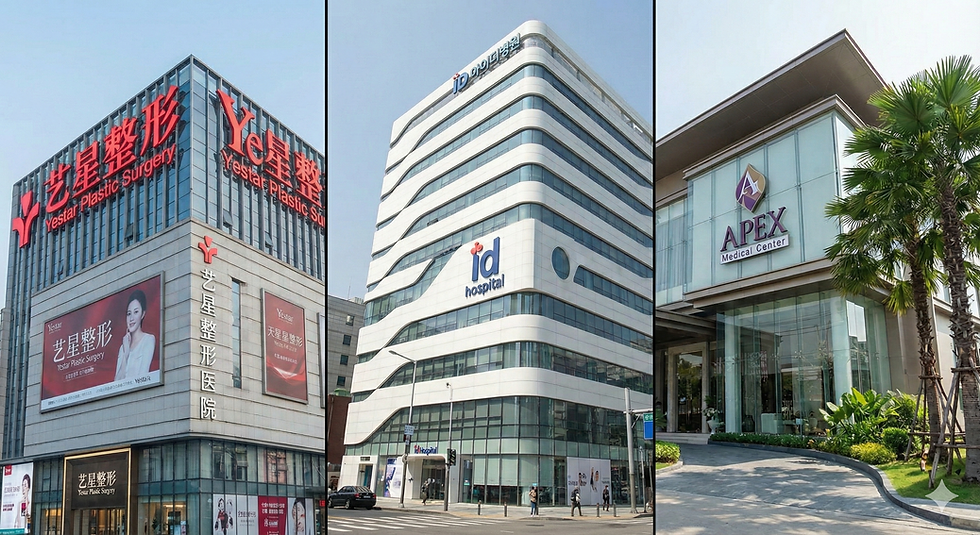
The Never-Ending Question,
"What Makes Korean-Style Clinics Different?"
Recently, while conducting consultations in China, and a few years ago during preparations to expand into Thailand and Vietnam, there was a question I heard most frequently from local partners.
"Exactly what is different about a 'Korean-Style Clinic'?"
I would like to summarize my thoughts on this fundamental question, which anyone preparing for the overseas expansion of a medical institution has likely faced at least once.
1. "The Market Wants Korea": Brand Power Built by Culture (2019 Thailand Case)
In 2019, while negotiating brand usage fees (royalties) with a partner in Bangkok, I was asked:
"Do we really need to use a Korean brand? There are already countless aesthetic clinics in the Thai market, and many of them have better facilities and services than Korea."
They were not wrong. However, my answer was clear.
"You don’t have to use it. But look at the billboards in Sukhumvit, Bangkok right now. They are plastered with K-POP stars like Blackpink. You hear K-POP playing in top-tier shopping malls like EmQuartier, and people are lining up at Korean restaurants. In this situation, do you really think a Korean brand holds no value? Isn't the real reason you sought us out because 'the market is demanding it'?"
Ultimately, the brand usage fee was agreed upon exactly as we proposed. This proves that in the aesthetic and plastic surgery market, the brand 'KOREA' has clearly moved beyond being just a country name to become a powerful marketing element that attracts consumers.
2. A 13-Year Time Gap: Narrowing Hardware, Widening 'Trust' (2025 China Case)
In 2025, I took on management consulting for 'X Aesthetic Surgery Clinic,' which boasts the longest history and largest scale in Shenyang, the northeastern region of China.
Their request was simple yet abstract: "Make us a Korean-style hospital."
Just 13 years ago, when I worked as a management director in the exact same region and at the exact same hospital, it was easy to find 'differences.' Simply transplanting Korean methods—such as dress codes, CS attitudes, and marketing content—was enough to be considered innovative. But things are different now.
The interiors and equipment in China have become nearly identical to those in Korea, and thanks to a highly developed VIP market, their hotel-style hospitality services sometimes even surpass Korea's. The superficial 'differences' are almost non-existent now.
So, what is different? The answer lay in the voices of the patients.
"Why do you visit a Korean hospital instead of a Chinese one?"
The answers from the Chinese patients I met all boiled down to one keyword: 'Trust.'
"I still cannot trust Chinese hospitals. I’m anxious about whether they use authentic products or if they tamper with the equipment." "Chinese doctors don't even take good care of themselves. I can't entrust my face to someone like that. Korean doctors have far superior skills and aesthetic sense."
Even high-status opinion leaders shared the same sentiment.
"My daughter wants to get a skin treatment, please introduce us to a Korean hospital." (Professor *** at Peking University) "Both my wife and I want to get treatments in Korea. Chinese hospitals are expensive, and I don’t know if they are actually good." (General Manager *** of BMW Distribution in Northeast China)
3. A New Definition: The Essence of K-Medical is 'Trust Capital'
Here is my new definition of a 'Korean-Style Clinic':
"In the aesthetic and plastic surgery industry, 'KOREA' has transcended being a country name and has itself become a brand that stands for 'A Reliable Standard of High Quality.'"
In 2004, I traveled to Paris, France, and Tokyo, Japan, for aesthetic market research. Back then, they were the leading nations. But over 20 years later, the dynamics of the market have shifted. Just like France and Japan in the past, Korea has now become the 'Origin' of aesthetic and plastic surgery, drawing attention not just from Asia, but from the entire world.
I define the competitiveness ratio of a Korean-style hospital as follows:
The Brand of Korea (Trust): 50%
The Clinical Superiority of Korean Medical Staff (Technology): 30%
Korean Marketing Content (Sensibility): 20% Of course, when foreign patients visit Korea, price competitiveness cannot be ignored. Compared to English-speaking countries and China, the price for authentic products/treatments is cheaper in Korea. However, many foreign patients who experience Korean medical services end up wanting the same services when they return to their home countries, and this demand eventually leads to the establishment of Korean hospitals overseas. The pricing structure is simply an issue that needs to be readjusted locally. [Key Points for Overseas Expansion]
First, Intangible Value Must Be Packaged into Tangible Assets.
Ultimately, for successful overseas expansion, the key lies in how we commercialize this 'Trust Capital.' Franchise fees and royalties are not created out of thin air. You must prepare financial data that proves your brand value, systematic clinic opening manuals, and training programs for local medical staff.
Second, You Must Select Partners with a 'Discerning Eye.'
I strongly advise against entering the market alone. There is no country in the world that simply allows foreigners to make money entirely on their own within its borders.
However, partnering with a real estate company that only has strong capital is not the ultimate solution, either. You need a partner who understands the unique nature of the healthcare business and possesses the 'legal and administrative problem-solving capabilities' to navigate strict local licensing and permitting issues.
Meeting the wrong partner is a fast track to wasting both time and money. Establishing the criteria to distinguish which partner is genuine is the very first step of overseas expansion.

Comments